B2B Data
18 min read
Buyer's Journey Intent Data: Map Signals to Every Stage

Arezoo Moghadam

Purchasing an intent data tool is easy; the real challenge is execution. Many teams stall because they struggle to translate raw insights into meaningful action.
You activate the tool and, within weeks, you're flooded with a firehose of data: trending topics, content downloads, and anonymous site visits. Yet, the critical piece remains missing: a clear, actionable signal that tells you who is truly in-market and which team member should step in.
Left without a clear path, this data often becomes expensive, unused 'shelfware,' ignored by SDRs who don't know where to start.
The issue isn't the data itself; it's the lack of a map. A blog visit is not the same as a pricing page visit: they signal different levels of intent and demand distinct responses.
This guide provides the map you need. We’ll break down how to align buyer's journey intent data with every stage of the B2B buying process, decode what those signals truly mean, and define exactly who should take action when they fire.
What is intent data?
Intent data refers to the set of behavioral and contextual signals that provide evidence that a person or account is looking for a problem that you solve and is likely in-market for a solution like yours. It enables you to connect with the proper accounts at the proper time, rather than merely guessing. Sourcing this information is entirely up to you, with a vast market of intent data providers at your disposal. Successfully interpreting these signals comes down to two key distinctions, which we will examine next.
Behavioral vs. contextual signals
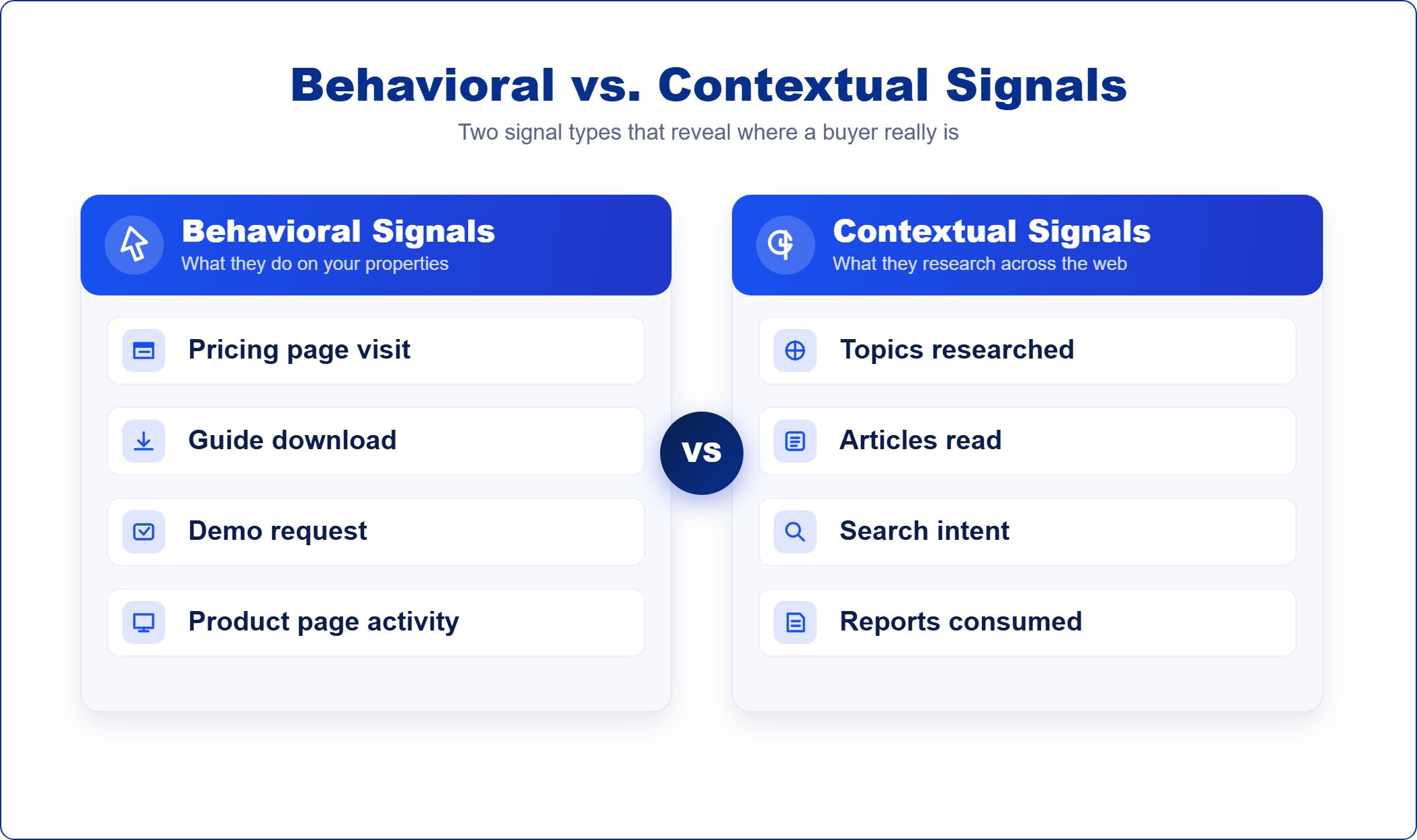
Behavioral signals are any action taken on a pricing-page visit a guide download, a demo request. They share information about what someone is doing, and that's typically the best gauge of their readiness to purchase.
Contextual signals: topics and content people are consuming when they're reading an article, the type of search they're doing, the theme of a report, or they reveal what a buyer is investigating; they put the issue on their mind before the buyer gets in touch with you.
First, second, and third-party intent data
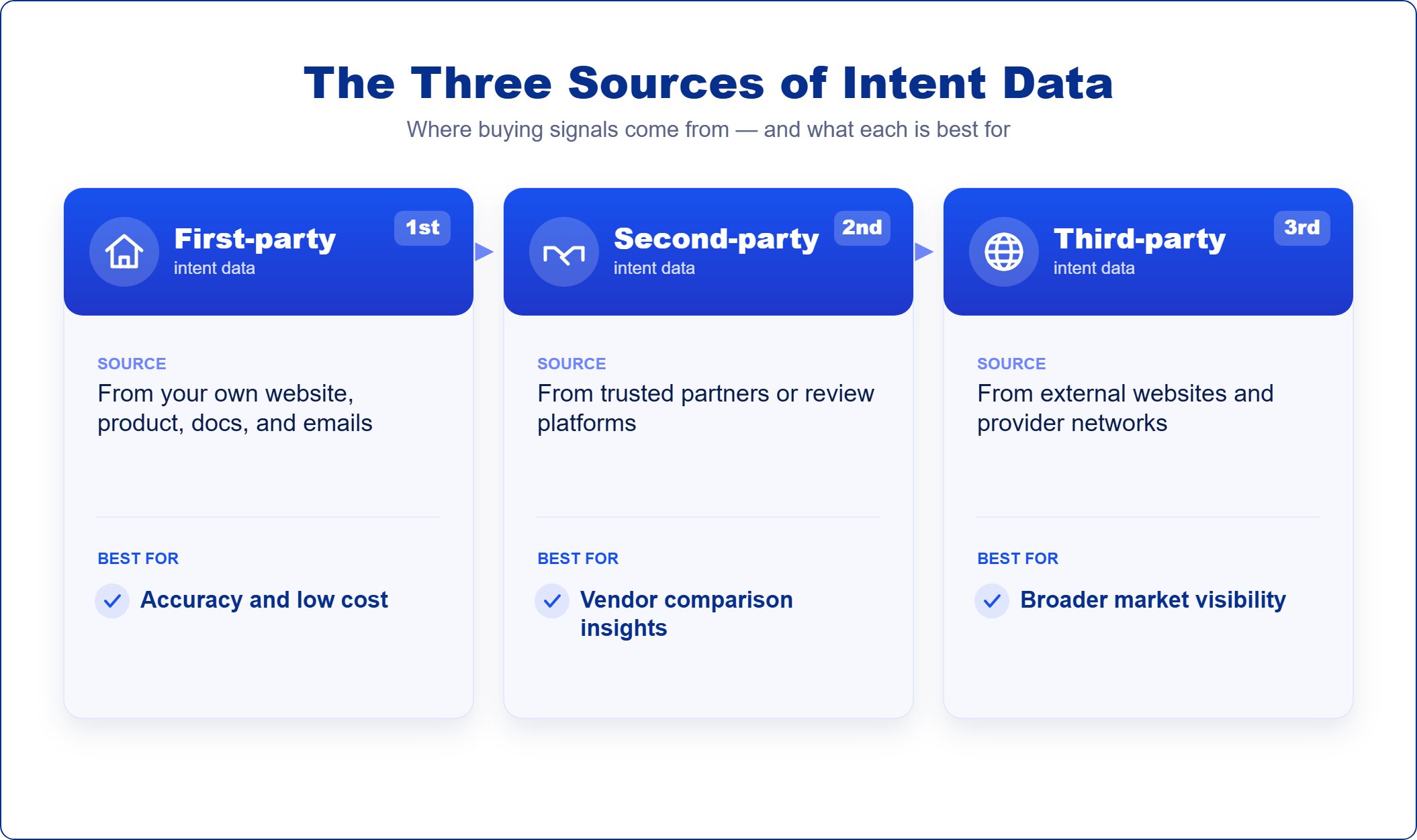
First-party intent data is the most accurate and the cheapest to collect data from, being that it is from your own properties: site, product, docs, and email.
Second-party intent data is data from a partner that is their first party data that they have provided directly to you, frequently from a review site where buyers are comparing vendors in your category.
Third-party intent data is compiled by a provider from sites you don't control, allowing you to peer into the research that is taking place in the broader market before a buyer gets to you.
They each have unique combinations of accuracy, price, and range. Discovering which type of data is better than the other, and why, is our breakdown of first, second, and third-party data.
The B2B buyer's journey intent data in 2026 and why it isn't a tidy funnel
The typical three-step process is: awareness (a buyer has identified a problem), consideration (the buyer is considering various options), and decision (the buyer is deciding on a vendor). This is a helpful map, and the rest of this article arranges signals by them. Use it as a guideline, not as a stepping stone. The neat funnel picture is broken by two realities as it loops, stalls, and restarts in real B2B buying in 2026. Reading them honestly is the difference between acting on intent data and misreading it.
You're selling to a buying group, not a person
B2B purchases are not typically made by a single person. Each of the users has their own research timeline, and the signals from a single account can be from multiple people that may not seem related in your data. This implies reading intent at the account level rather than just contact level. A single pricing visit from one lead is weak; three leads from the same company, a case study, and a comparison page returned in the same week is a buying group warming up.
The "dark funnel"
In most cases, none of your research will be reflected in your analytics. By the time buyers fill out a form or hit a page you can track, they've already self-educated themselves (probably on third-party sites, communities, and review sites). When someone realizes they are on their journey is halfway done. This is one of the reasons why third-party intent is so important to generate in-market accounts that you'll never see in your own funnel, because it allows you to convert anonymous research into prospect data.
How to map intent data to each stage of the buyer's journey
Collecting the signals is the easy side of the equation; the difficult part is interpreting what each one conveys in the context of who to reach out to and where the buyer is. Below is the map overview, followed by a detailed description of each stage.
Stage | Buyer mindset | Signals that fire (first-party/third-party) | Who acts, and how |
|---|---|---|---|
Awareness | "We might have a problem." Researching the issue, not vendors. | 1P: top-of-funnel blog and guide reads, first anonymous visits. 3P: surging research on category topics and problem themes across the web. | Marketing. Nurture with educational content and contextual ads. Hold sales back. |
Consideration | "Which kind of solution fits?" Comparing categories and approaches. | 1P: repeat visits, comparison and solution-page views, webinar/whitepaper engagement. 3P: "best [category]" and "alternatives" research, review-site activity. | Marketing into light sales. Retarget, serve proof, let scoring trigger an SDR touch on engaged accounts. |
Decision | "Which vendor, and can I defend the choice?" Building the business case. | 1P: pricing visits, demo/contact requests, several people from one account active in days. 3P: competitor-comparison and competitor-name research. | Sales, fast. Alert the owner, prioritize the account, multi-thread the buying group with tailored proof. |
Awareness-stage signals and what to do
The mindset. The buyer is not shopping for a vendor; they are stating a problem. You might not even have an idea of what your category is.
What fires. Increased overall problem and topic research, education content consumption, and trend in category themes. Most of this is third party, because it occurs outside of your website; the first party is somebody who is reading a top-of-funnel post, or downloading an intro guide.
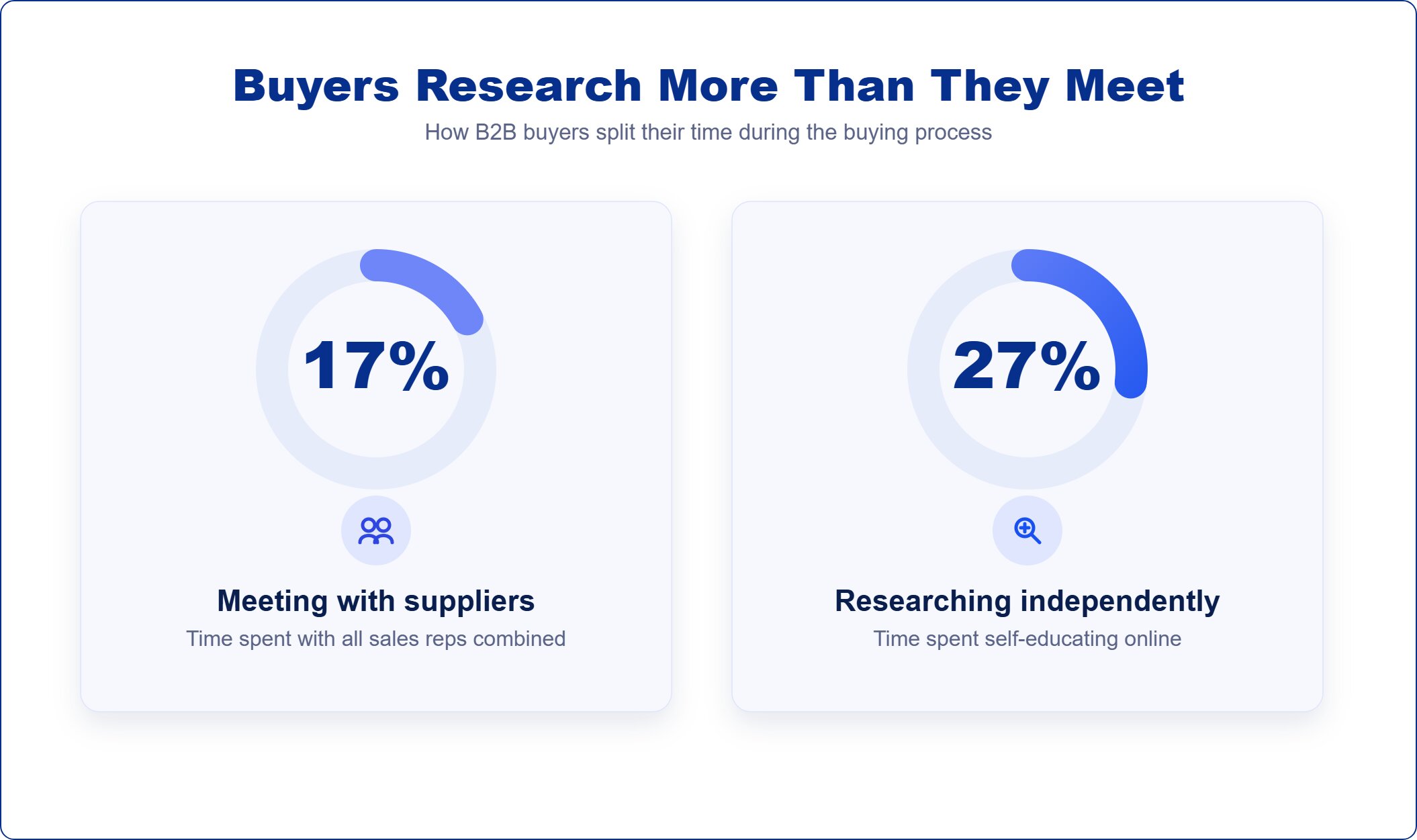
What it means. Real interest, but early: They have a high volume, low purchase intent, and they're not really visible to you. During the buying process, B2B buyers have only about 17% of their total time spent with possible suppliers and about 27% being spent researching on their own online. A sales call at this level is premature because the buyer is very self-educating.
The play. This is the responsibility of marketing. Support through education and engage in contextual or brand advertising to be seen when people are researching, deploying around intent signals. A rep touch is premature, and he or she has lost goodwill.
Serve. Blog posts, explainers, and problem-framing thought leadership that gets a buyer thinking about what the problem is.
As an example, an account which has never been on your site begins to increase across third-party sources on "employee onboarding compliance". Include it in a nurture list. Avoid firing an SDR sequence.
Consideration-stage signals and what to do
The mindset. The buyer has come to terms with the issue and is now considering solution categories and solution approaches. You're probably on to their shortlist.
What fires. Solution-category searches and “how to” content, comparison and “alternatives” content, webinar and whitepaper engagement, and repeat visits from same account. First party is product page views and gated downloads, while third party is "best [category] software" research and review-site activity.
What it means. Moving from "I have a problem" to "which solution. This is where buyer intent score comes into play because frequency and depth distinguish a casual browser from the serious evaluator.
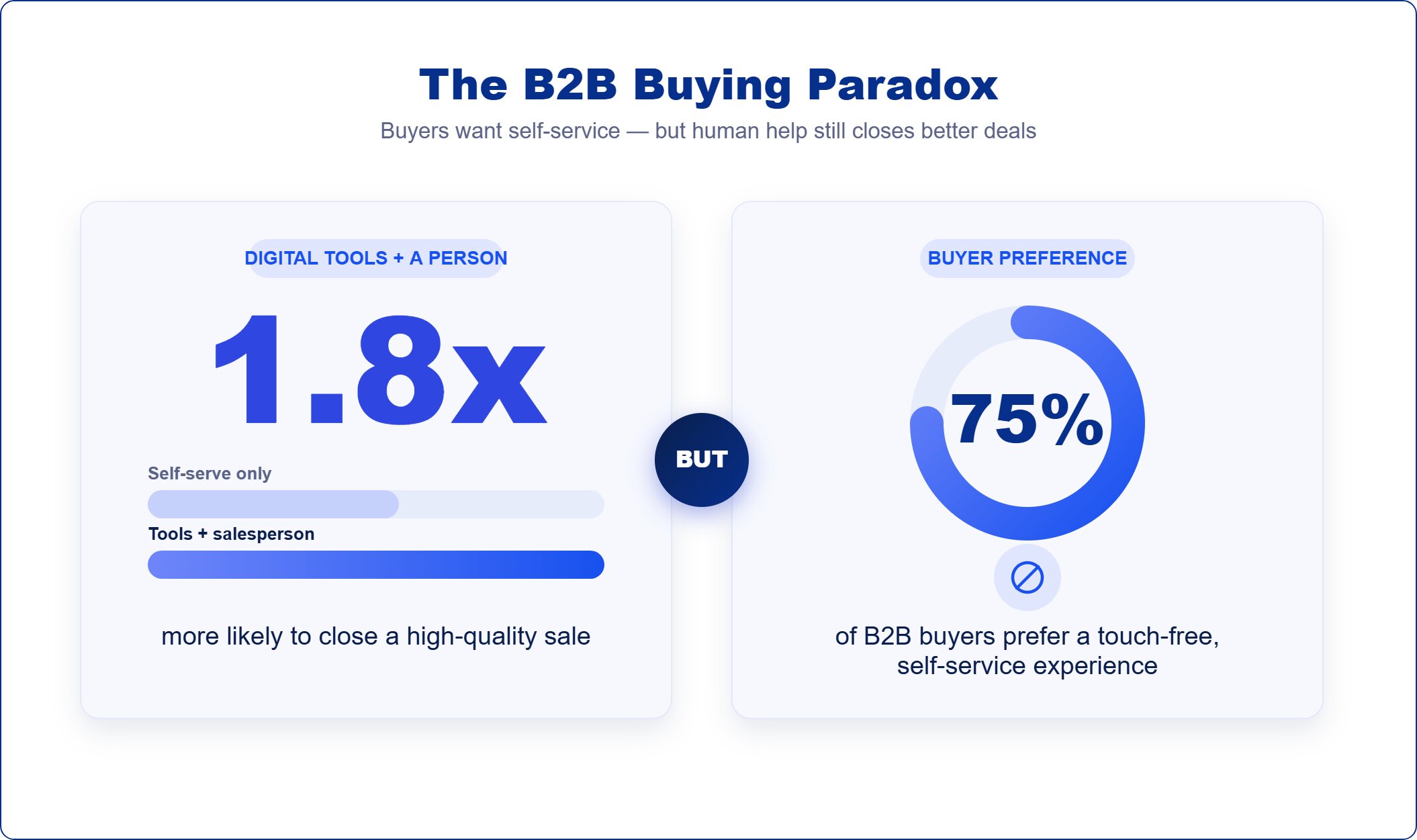
The play. Provide content and retargeting that is solution-focused, and have a measured human touch start. But when buyers use supplier digital tools in addition to the salesperson, they're 1.8 times more likely to close a high-quality sale than when they use the tools without the salesperson. Meanwhile, approximately 75% of B2B buyers state that they want to have a touch-free experience, and that touch should not get in their way. Retargeting is the heart of the marketing action here; the mechanics are located in the "Retargeting Interested Visitors" portion of our intent data guide.
Serve. Comparisons, solutions and category pages, case studies, etc.
As an example, a recognized account might visit your pricing page, download a comparison guide, and return a couple of times a week. Once their score crosses the threshold, a context-aware notification is triggered instead of an aggressive sales pitch.
Decision-stage signals and what to do
The mindset. Selection of a vendor, internal Business Case. This is the mode for risk-reduction.
What fires. Pricing-page visits, demo or contact requests, competitor-comparison pages, and the best of all: multiple stakeholders from one account active within a short period of time. Third party appears as competitor-name and "[competitor] vs" research.
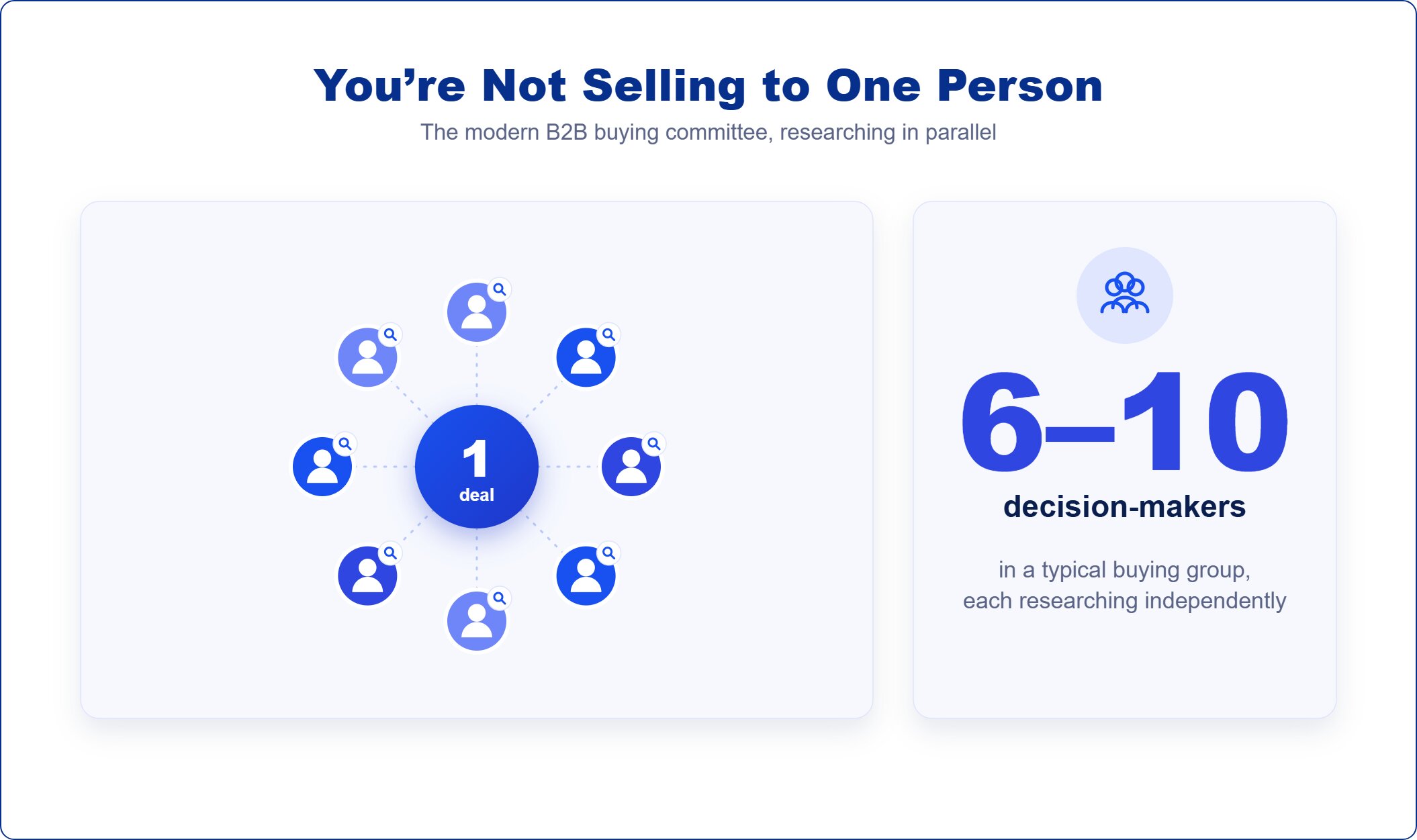
What it means. An opportunity with a buying group, where the product is in its late stage and active. A typical B2B buying group consists of six to ten members, each having done their own research, so if the lights are all on at once, you're witnessing the buying group.
The play. Marketing passes on context to the account and arms off fast. Sales starts an alert, gives priority to the account, and sends out specific outreach to the entire committee. The signal is to the account, not the individual lead, which means that you'll still need to connect with each stakeholder, you'll need verified, up-to-date contact information for all the members of the buying group, and you'll need to use lookalike search to find similar accounts that are active in the market. AI Ark was created to do just that: a step down.
Serve. Pricing, ROI, and business-case material and customer references.
For instance, a VP, an analyst, and an end user from the same organization landed on the pricing page, the case study, and your competitor-comparison page within 48 hours. Contact the AE and involve all three with relevant evidence as appropriate.
Retention and expansion signals (post-purchase)
It's not over at the sign of the contract. Once the sale, keep an eye on the product-usage patterns, support and docs activity, renewal-window activity, and interest in expansion features, as these are all buying signals for growth or churn. The plays listed in the "Retention and Upsell Opportunities" section of our intent data guide are live plays, and aren't repeated here.
First-Party vs. Third-Party Intent Data Across the Buyer's Journey: What Actually Changed
The narrative that many articles continue to tell, that third-party cookies are dead and that you need to move everything to first-party, is incorrect based on the facts.
In July 2024, Google reversed its plan to deprecate Chrome, and in April 2025, it announced it wouldn't even implement the user-choice prompt to remove cookies from its ecosystem; by the end of 2025, Google had scrapped the Privacy Sandbox initiative that was intended to phase out cookies entirely. Third-party cookies are still with us. The more subtle shift is that Safari and Firefox already block them by default, meaning that about a third of all web traffic will be cookieless by default already, and the transition to first-party signals isn't happening because cookies are dying; it is a consequence of privacy regulation and coverage gaps. When it comes to intent data, it's not a matter of which tracking technology remains. This is about which type of signal will fit where in the trip.
Where third-party data fits: finding the accounts you can't see
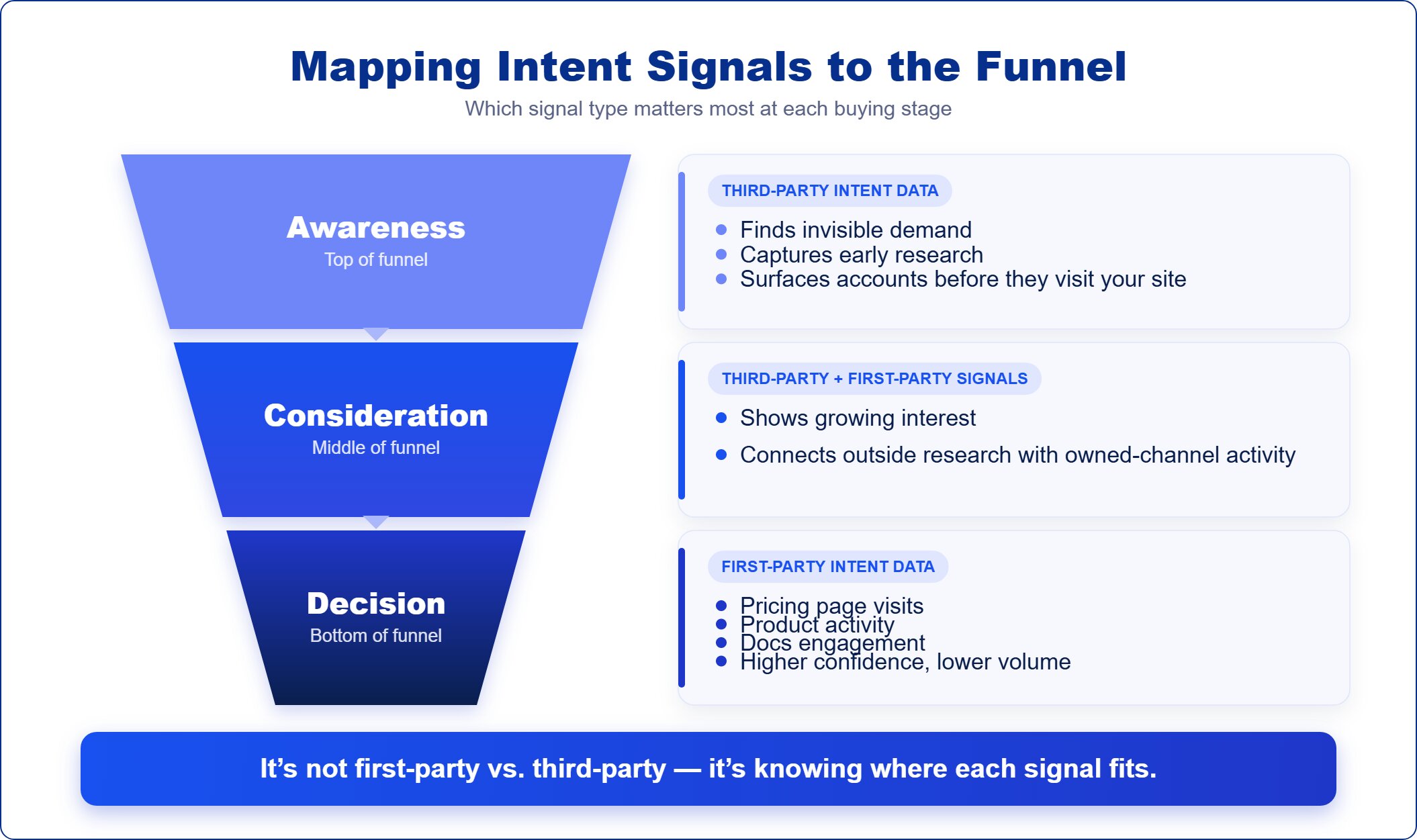
Third-party intent is at the top of the funnel, and it does something that first-party intent can't;
Surfaces invisible demand: Pre-profile research about your category at non-affiliated sites, without visiting your website or filling out your form.
Supplies the awareness stage: captures the attention of the accounts before a first-party signal could even possibly occur, whenever they're still self-educating.
Where first-party data fits: precision at the bottom
At the consideration and decision level, first-party intent is more powerful and accurate than reach:
Eliminate the guesswork: Once someone is on your owned channels, your pricing page, docs, or product, you know who they are and what they're doing.
More confidence, less volume: As the deal moves towards closer, it should have less volume and more confidence.
Privacy and consent: handle with care
B2B intent data is placed under the real obligations. B2B marketing is more prevalent in the EU, where it can rely on the “legitimate interest” principle as a legitimate basis under the GDPR, though this is not carte blanche; as with any other legitimate basis under GDPR, it requires a documented balancing test and, where cookies are being used to track visitors, the ePrivacy rules still require consent. U.S. B2B exemption for the California Consumer Privacy Rights and Accountability Act/California Privacy Rights Act (CCPA/CPRA) expired in January 2023, which means that business contacts are now considered customers. The details may differ from one jurisdiction to another, data type to data type, and use case to use case. Such a statement is not a legal opinion. Consider rules as a living document and get legal advice from trusted advisors before operationalizing rules.
How to Build a Buyer's Journey Intent Data Workflow
Only when the signal-to-stage map runs as a repeatable workflow is it of value. Let's take a look at how we can make it happen in 5 steps:
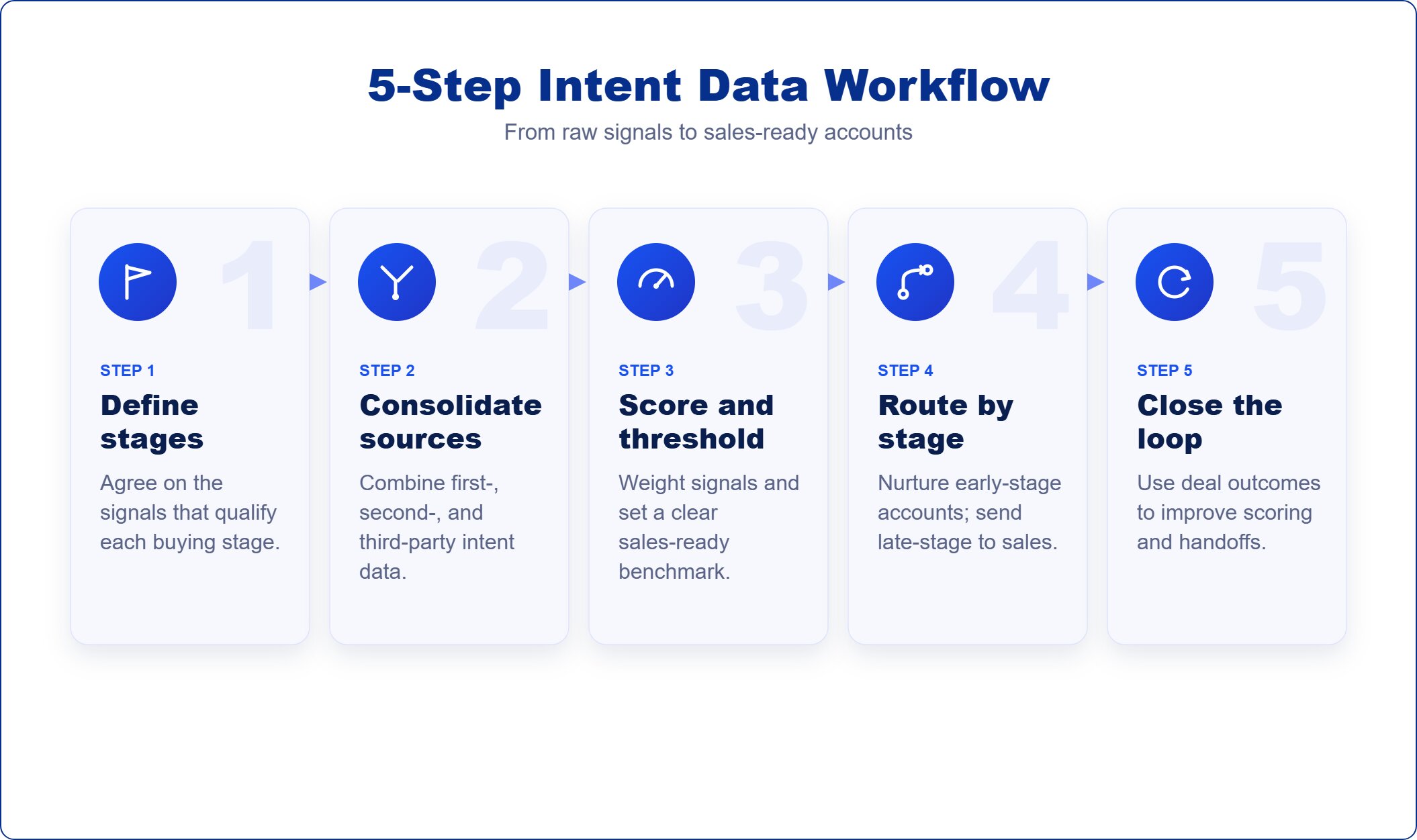
Identify stages and qualifying signals. Have sales and marketing in the same room and come up with a consensus on what constitutes a sales-ready lead at each phase. Communicate it in a common SLA; don't let anyone debate later about what a "consideration" account is.
Consolidate your sources. Integrate first, second, and third party signals into a single view. When you read them in one place, you can get a view of the pattern of an account, multiple stakeholders, and multiple touches, rather than isolated clicks.
Score and threshold. Attach weight to each of your customers' signals, so that you don't have to do outreach before they've had one of your visits that has a low intent level, and establish a threshold for when an account is "sales-ready. High b2b data quality is the only way to get high-quality alerts from here.
Route by stage. Take early-stage accounts to automated nurture, and leave late-stage signals for humans. Take advantage of b2b data segmentation and have the right action automatically performed instead of waiting for someone to triage a list.
Close the loop. Include the results of feed deals in the system. Identify successful signals and unsuccessful ones and make the model even more precise with each cycle.
Common mistakes when using intent data across buyer’s journey
Intent data is more likely to fail due to its use than due to the data. Teams acquire a good tool, turn it on, and then get into the same few traps: responding to the wrong signals, acting too late, or acting on the wrong person altogether. This ends up with lost time and effort in selling the items, irate customers, and a growing distrust of the tool, and not the tool itself. Fortunately, most of these errors are avoidable if you know to look for them. These are the most frequently found ones:
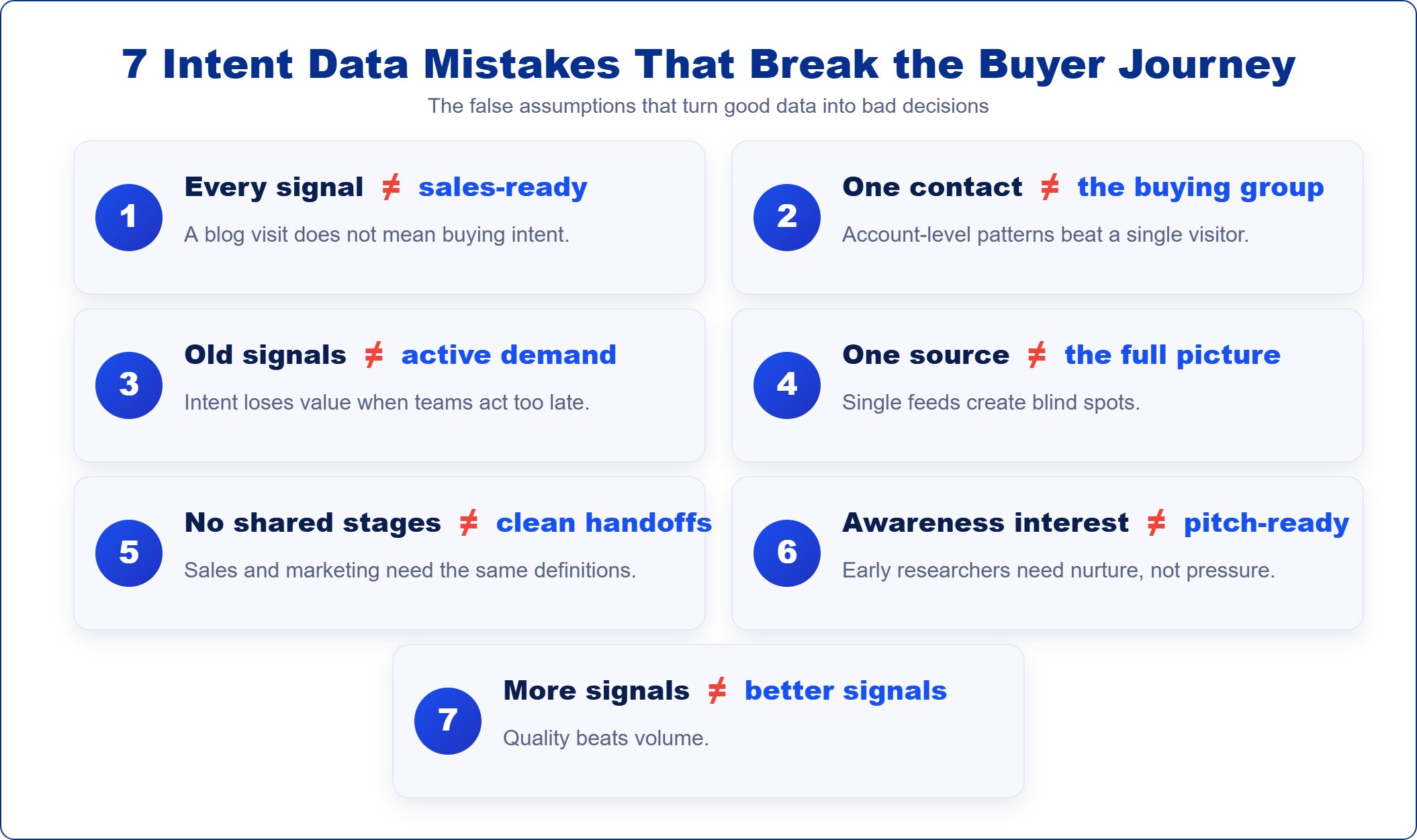
Assuming that all signals are sales-ready. The blog visit isn't a buying decision. Always firing sales outreach at every signal will lose the goodwill and teach your team to ignore data.
Ignoring buying-group context. When it comes to the decision, you can't act on one contact if you're not seeing the big picture. One is small; a few from one company is the good indicator.
Taking action on old signals. Intent decays fast. A high rise in a month might be a deal already done with another company, so the timing is a signal as well.
Over-relying on a single third-party source. One feed provides one perspective, and that's its perspective. Don't assume a signal is real without cross-referencing.
There are no agreed stage definitions. Handoffs are lost, accounts go unfilled when sales and marketing don't have a shared definition of each stage.
Following up on sales from awareness stage browsers. Early researchers don't need a pitch, and an early sales touch tends to turn them off.
Focusing on quantity rather than quality. Too many signals are not good. Some sure signals are followed; thousands are not.
How to measure intent data's impact on buyer’s journey
Use outcomes, not activity, to measure intent data. The number of signals, topic surges, and "accounts engaged" may look productive on a dashboard, but they don't mean anything if they didn't generate revenue. The true test is what happened to your pipeline.
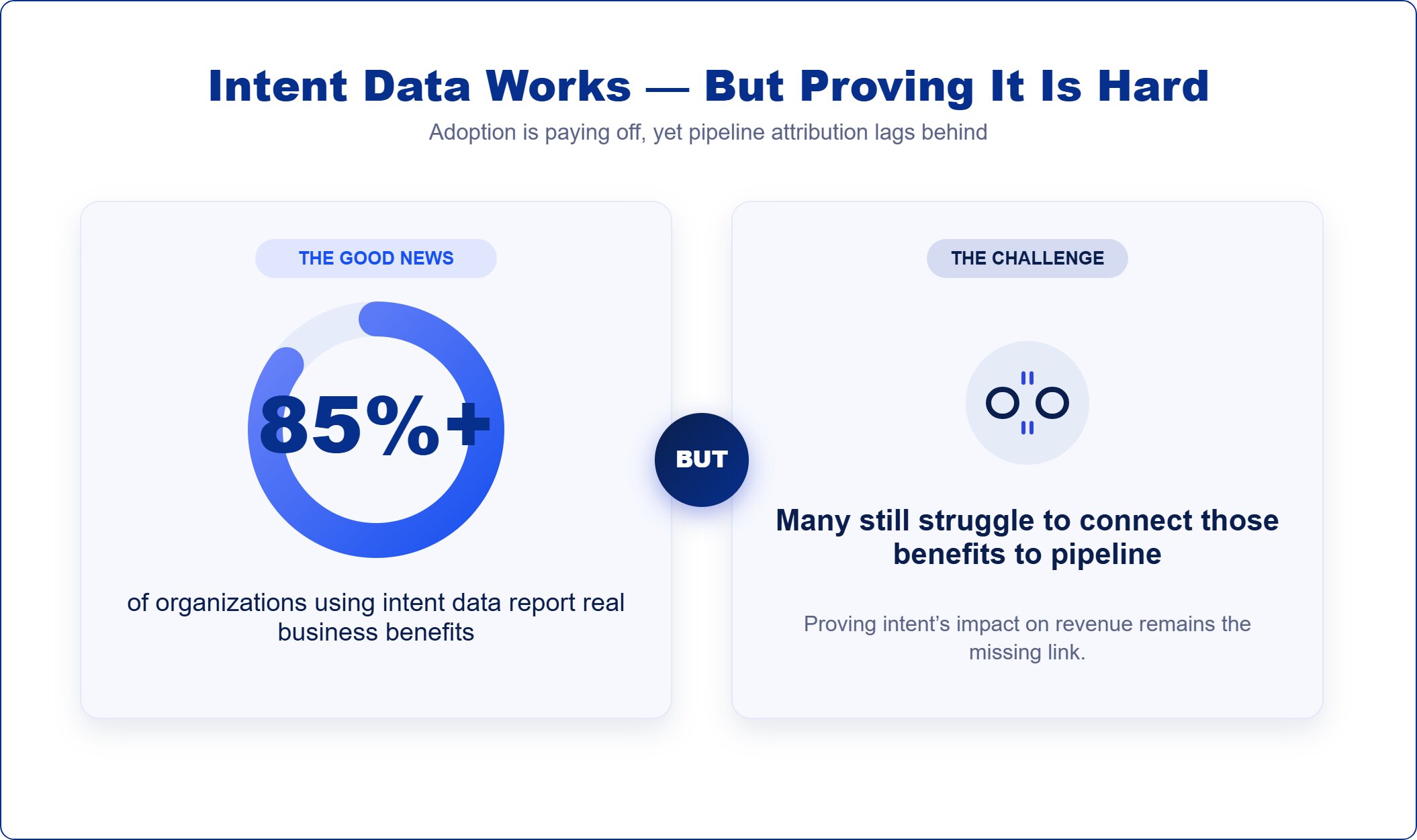
The norm isn't the exception: According to Forrester's Global B2B Intent Data Survey, more than 85% of organizations that are leveraging intent data report some business benefit, but many struggle to link intent data to pipeline because they are not measuring consistently around it. It is closed by four outcome measures:
Pipeline influenced: value of the opportunities that exhibited an intent signal prior to creation.
Conversion rate by stage: if intent-flagged accounts move from one stage to the next more frequently than non-accounts.
Speed-to-engagement: the time it takes you to react after a high-intent signal activates.
Win rate on intent-sourced deals: deals that started with a signal that had a higher win rate than deals that didn't begin with a signal.
There's one important note of caution: the attribution is not perfect. There are many things a buyer will touch prior to buying, and you can't prove a single touchpoint made a sale. Measure directionally and, where possible, compare a group of intent-actioned accounts to a similar group of controls that were not worked on intent. That comparison statement is worth more than any individual attributed number.
Putting buyer's journey intent data to work
Intent data alone is as effective as what you do with it. The moment you have mapped the signal to a stage, and you have assigned a clear owner to it, it becomes useful, and when the teams that win start to make it into a repeatable play, they are the ones that will succeed.
You now have the map: what does each signal mean and who should take action at each stage? The portion that makes it pipeline is reach. Once a signal alerts you to an account being in-market, AI Ark will provide you with verified emails and direct dials for the entire buying group, as well as lookalike accounts you've yet to discover, giving you the opportunity to capitalize on the intent while it is still alive. Schedule a demo and witness the speed at which a flagged account turns into a list of the right set of contacts to call.
FAQs About Buyer’s Journey Intent Data
What is buyer intent data?
Buyer intent data is a series of behavioral and situational indicators that illustrate that a person or business is actively pursuing a problem or solution you provide. Behavioral signals are actions that are taken, like visiting the pricing page, downloading content, requesting a demo, etc. Contextual signals are the topics that are being researched. They together show you which accounts are in-market and also broadly just how close they are to purchasing, and you can focus outreach on the ones that are in-market, instead of just on best guesses.
What are the 5 stages of the buyer's journey?
The stages of the buyer's journey are typically divided into three parts: awareness, consideration, and decision, and five parts when you add the post-purchase stages. The 5 stages are: (1) Awareness, problem identification; (2) consideration, solution types; (3) decision, vendor selection; (4) retention, adoption and renewal; and (5) advocacy or expansion, purchasing additional solutions and recommending other solutions. Intent signals are evident in every phase, but they are most pronounced and discernible from awareness to decision.
What is an example of a buyer's journey?
Imagine that a company has an onboarding issue. During the awareness stage, the employee is looking up information on third-party websites, but does not interact with your site. In consideration, that account visits your solution and comparison pages and downloads a guide. In the decision stage, a VP, an analyst, and an end user, all from the same company, look at your pricing and competitor-comparison pages within a couple of days, and they come to a decision. The signals vary across the different stages, and so do the reactions, ranging from marketing nurture at the beginning to the rapid sales conversion towards the end.
What is the difference between first-party and third-party intent data?
First-party intent data is always the most accurate and least costly data to collect, and it is strongest at the consideration and decision stage, as it comes from your website, product, docs, and email. Third-party intent data is collected from sites you don't own and can be used to identify accounts researching your category before they get to you and is most useful at the awareness stage. Most teams use both third-party for in-market accounts, but also first-party to confirm and prioritize in-market accounts.
How do you know which stage of the buyer's journey an account is in?
You read the stage from the signals. Broad topic and educational research points to awareness; solution comparisons, pricing views, and category searches point to consideration; demo requests, competitor-comparison pages, and several stakeholders from one company active at once point to decision. The pattern matters more than any single click: frequency, depth, and how many people from the same account are engaged tell you how far along the buying group really is. B2B buying groups typically run six to ten people, so multiple contacts lighting up together is one of the clearest late-stage tells.

