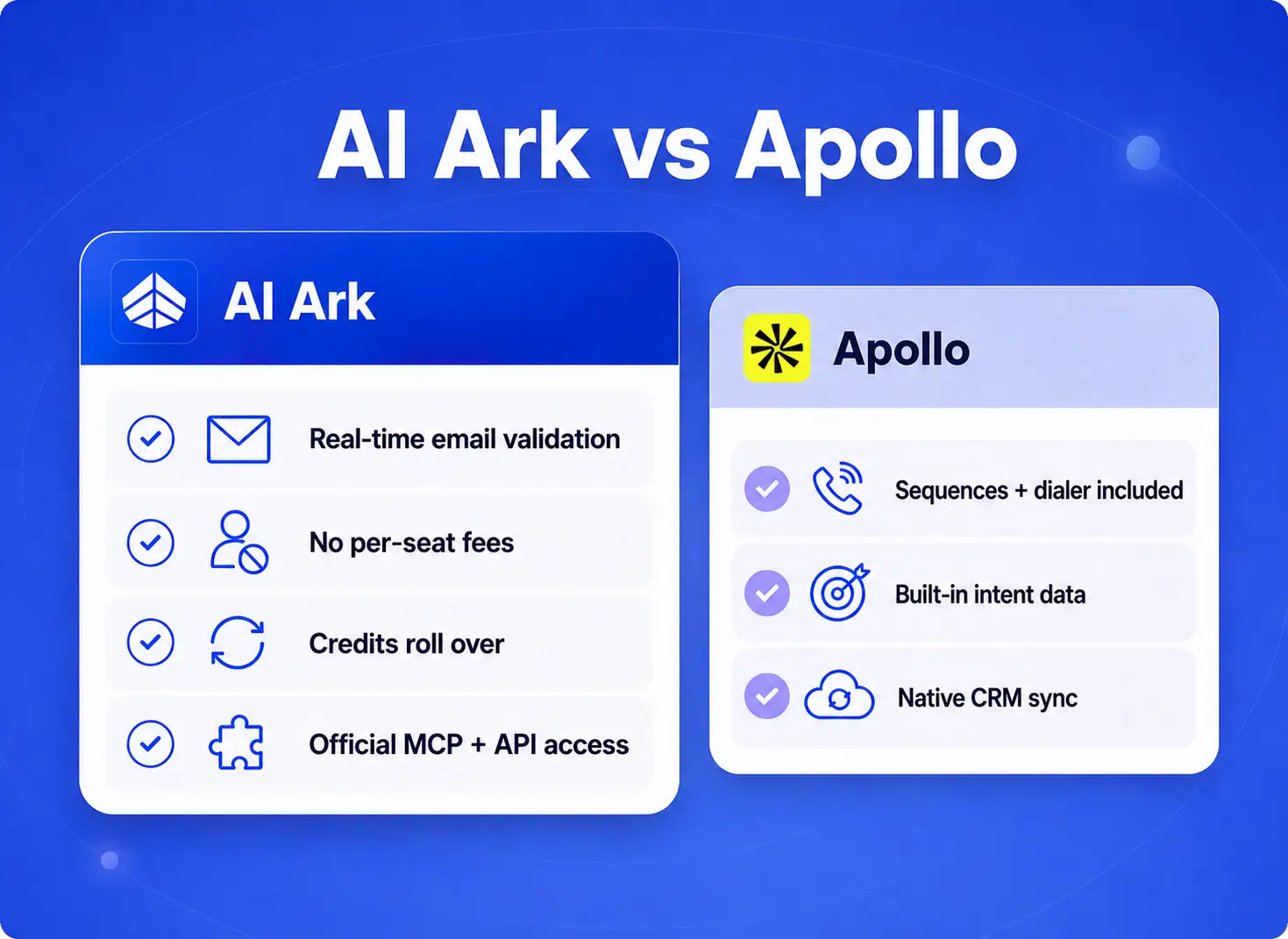
AI Ark is the Apollo alternative for teams that own their outreach stack and want a verified, ready-to-send file: every email checked at export, credits that roll over, no per-seat fee. Apollo is for teams that want data, sequences, and a dialer in one subscription. Pick by which job you are hiring for.
Key takeaways
Different scope. AI Ark is a company and people discovery database that hands you a verified export. Apollo puts a database, sequences, a dialer, and CRM sync under one login.
Different point of validation. AI Ark verifies every email with BounceBan at export, so the file holds only valid addresses. Apollo verifies upstream and labels each record with a status, publishing 91% accuracy for Verified emails.
Pricing models aren't directly comparable. AI Ark charges per output (0.5 credits per profile, 0.5 more only when a valid email is found) from a team-wide pool. Apollo charges $49 to $119 per seat per month on annual billing plus a per-seat credit pool, at 1 credit per email and 8 per mobile.
Credit rollover. AI Ark credits roll over up to 2x your monthly plan. Apollo's unused credits expire at the end of the billing cycle.
Refresh cadence. AI Ark re-processes the whole database every 30 days. Apollo refreshes on signals such as job changes, plus monthly checks.





AI Ark vs Apollo at a glance
Feature | AI Ark | Apollo |
Category | B2B prospect and company discovery database with verified export | All-in-one sales platform |
Database size | 400M+ people, 70M+ companies, global | 240M+ people, 30M+ companies |
Email validation | Real-time SMTP and catch-all check via BounceBan at export; only valid addresses in the file | Status label per record |
Published accuracy | Only addresses that passed verification are delivered; bounce rate under 1.5% expected | 91% accuracy on Verified emails |
Catch-all addresses | Verified individually; delivered only when confirmed valid, labelled "Catch-All Valid" | Separate status, off by default |
Database refresh | Full database every 30 days | Signal-triggered plus monthly checks |
Pricing model | Credits per output, pooled across the team, no per-seat fee | Per seat plus per-seat annual credit pool |
Published entry price | $49/month for 5,000 credits | $49/user/month on annual billing |
Credit rollover | Yes, up to 2x monthly plan | No |
Free tier | Yes; run searches and see counts without a card | Yes, 900 credits/year |
Invalid-email charge | None; 0.5 credits for the profile only, 0 for the missing email | Refund if a Verified email bounces within 30 days |
Native CRM sync | API, Clay, n8n, Make, Zapier | Yes |
API | Yes; same credit price as the web app, 300 requests/minute | Yes |
MCP server | Yes; works in Cursor, Claude, and Windsurf | Yes |
Export ceiling | 10,000 per batch, unlimited batches via Net New | Plan-dependent cap |
What Teams Say About AI Ark

“Since switching from Apollo to AI Ark, bounce rates are around 1% and ‘wrong person’ replies are rare. We export clean, verified data in under five minutes, and Saved Records prevents paying twice for the same contact. It’s cut list-building costs and made our GTM engineers far more efficient.”

Dean Fiacco
Founder @ Beanstalk
What is AI Ark?
AI Ark is a B2B search engine and data provider for outbound teams, agencies, and RevOps people. You search 400 million people and 70 million companies, select the records you want, and export a CSV.
The assumption underneath the product is that you already own your outreach stack. AI Ark's job is not to send the email; it is to hand you a file that goes straight into Smartlead, Instantly, Email Bison, Clay, or your CRM with no verification step in between. Every email is checked with BounceBan at export, catch-alls included, and only valid addresses make the file.
Four things set it apart. Company Lookalike takes up to five of your best customers' URLs and finds companies that do the same thing, judged on what they sell rather than how big they are. Net New vs Saved Records means a contact is charged once; export it again a year later and it costs nothing. The filters go a level deeper than most databases: headcount growth over 6, 12, or 24 months, employees by department, time in role separate from time at company, and the person's location separate from the company's HQ. And search itself is more precise, with economic zone filters, Premium and Open to Work badges, and Smart, Word, or Strict title matching so you get the roles you meant, not the ones that share a word.
What is Apollo?
Apollo is a San Francisco company founded in 2015 that sells a go-to-market platform for B2B sales teams. It pairs a database of 240M+ people and 30M+ companies with an execution layer: sequences, a dialer, buying intent, a Chrome extension, and native Salesforce and HubSpot sync, plus an API and MCP server for teams that build their own.
Its data comes from four sources: a contributor network of over two million users who share business contacts while using the product, bounce and reply signals from its own sending tools, public web crawling, and vetted third-party providers. When you connect a mailbox, Apollo may extract contact information from your email and calendar into that network once multiple accounts confirm the same data. Emails pass a seven-step verification and get a status (Verified, Unverified, Update required, Unavailable, User managed, Catch-all); Apollo publishes 84% match and 91% accuracy for Verified emails. Records refresh when a signal such as a job change arrives, with monthly checks.
Pricing is public and self-serve: Free, then Basic at $49, Professional at $79, and Organization at $119 per user per month on annual billing, each with a per-seat annual credit pool. It suits founders and small teams who want one subscription for data, sending, and calling, and larger orgs that want SSO and governance.


Data quality: where validation happens
The core difference is not how much data each holds. It is when the email gets checked and what happens to the ones that fail.
How AI Ark does it
When you export with valid emails selected, every address runs through BounceBan in real time, standard SMTP and catch-all alike, which is why a verified export can take up to 30 minutes.
The file contains only valid emails. Invalid, unknown, and risky addresses are dropped, not delivered with a warning label. Catch-alls get the same treatment: if BounceBan confirms the specific mailbox exists it is delivered as "Catch-All Valid"; if not, it is left out.
About 70% of contacts in an export come back with a valid email, at 0.5 credits for the profile plus 0.5 for the email. The other 30% cost 0.5 credits and still carry the LinkedIn URL, title, company, and firmographics. We expect a bounce rate under 1.5%; rather than take that on trust, export the segment you would pull from Apollo and see what your sending tool reports.
How Apollo does it
Apollo verifies upstream. Its seven-step process combines SMTP checks with signals from its contributor network, connected mailboxes, and bounces and replies from emails sent through Apollo. Every record gets a status; Verified emails cost 1 credit and Unavailable costs nothing.
Its help center publishes an 84% match rate and 91% accuracy for Verified emails; its marketing pages cite 98%, and the two are not reconciled. If a Verified email bounces within 30 days, Apollo says it refunds the credit automatically; the article does not say how bounces are detected when you send from another tool.
Apollo holds 4.7 out of 5 on G2 across 9,823 reviews as of 6 September 2026; G2 groups 469 under "inaccurate data", 412 under "outdated data", and 366 under "email issues". One business development manager, reviewing on 25 August 2026, reports 15% to 25% bounce rates when leads are not verified before sending.
The trade-off, stated fairly
Apollo's model shows you an email status before you spend a credit, and results appear instantly. AI Ark cannot pre-filter by email status, because it does not know which emails are valid until the export runs.
AI Ark's model is fresher at the moment it matters: a status set weeks ago can be wrong today, and a check run at export cannot be older than the export. The cost is a wait on large exports and an unknown find rate until the job finishes.
Pull the same 500 contacts from both, send from the same tool with no verifier in between, and compare bounces at day seven.
True cost: what a valid lead actually costs
List price is the wrong number. Apollo prices the seat; AI Ark prices the record. The number that transfers is the cost of one email that lands.
Published pricing
Apollo plans, per user per month, annual billing :
Apollo plans:
Plan | Credits per seat per month | Monthly billing | Annual billing (credits per seat per year) | Seat minimum |
Free | 75 | $0 | $0 for 900, granted monthly | 1 |
Basic | 2,500 | $65 | $49 for 30,000, granted upfront | 1 |
Professional | 4,000 | $99 | $79 for 48,000, granted upfront | 1 |
Organization | 6,000 | Annual only | $119 for 72,000, granted upfront | 3 |
credit costs: 1 credit for a verified email or profile enrichment, 8 more if a mobile number is returned; credits expire at the end of the billing cycle. Vendr puts the median Apollo contract at $17,780 a year across 96 purchases.
AI Ark plans:
Plan | Credits per month | Monthly billing | Annual billing (credits per year) | Seats included |
Free | 100 | $0 | $0 | 1 |
Starter | 5,000 to 30,000 | $49 to $119 | $470 for 60,000 to $1,142 for 360,000 | Up to 3 |
Builder | 60,000 to 300,000 | $219 to $879 | $2,102 for 720,000 to $8,438 for 3,600,000 | Up to 5 |
Scale (Agency & Enterprise) | 450,000 to 5,000,000 | $1,249 to $9,999 | $11,990 for 5,400,000 to $95,990 for 60,000,000 | 10 |
AI Ark's credit costs: 0.5 for a profile, 0.5 more only when a valid email is found, 5 for a mobile, 0.1 for a company record; unused credits roll over up to 2x the monthly plan.
A worked scenario
Take a team that needs 5,000 verified contacts a month and sends from its own tool.
On Apollo that is 60,000 verified emails a year. Two Basic seats on annual billing cover it at $1,176 a year, or $19.60 per 1,000 verified emails. Apply Apollo's own 91% accuracy and about 54,600 are valid, so the all-in cost is roughly $21.50 per 1,000 valid emails before any verifier pass.
On AI Ark, 5,000 valid emails at a 70% find rate means exporting about 7,150 contacts: 3,575 credits for profiles plus 2,500 for emails, roughly 6,100 credits a month. The 15,000-credit plan at $79 a month covers that, so the all-in cost is $948 a year for 60,000 valid emails, or $15.80 per 1,000. On the annual 180,000-credit package it is $758 a year, or $12.60 per 1,000. Unused credits roll over for the months when volume grows.
On AI Ark you only pay for the address after it passed, and there is no seat.
The counterpoint, stated honestly
If you have no sending tool, no dialer, and no CRM enrichment, the comparison changes: you would be buying those separately anyway, so weigh Apollo's seat against that whole stack, not against AI Ark alone. One Basic seat covers all of it for $588 a year.
The hidden line item is verification. Send Apollo data unchecked and you are trusting a status set at some earlier date; several Apollo reviewers say they run a verifier first, a second tool and invoice. Apollo's help center argues the opposite: third-party verifiers wrongly reject valid catch-alls, so Apollo should be your verifier. AI Ark removes the step by running the check inside the export and charging nothing when it fails.


Features side by side
Finding the right accounts
Feature | AI Ark | Apollo |
Company search with firmographic filters | Industry, location, revenue, actual headcount (not self-reported range), founded year, technologies, funding | Yes |
AI Lookalike (semantic company matching) | Up to 5 seed URLs; matches on description, SEO text, products, and keywords; add a result with "+" to retrain | Yes; up to 5 companies, firmographic matching |
Headcount growth filter | Minimum % growth over 6 months, 1 year, or 2 years | Yes |
Employees by department | Yes; e.g. large Engineering, small Sales | Yes |
Technographics | Yes | Yes |
Funding | Yes | Yes |
Bulk company input | Paste up to 10,000 domains or LinkedIn URLs, then "Find People" across that list | Limited |
Both cover the standard set. AI Ark filters on measured headcount rather than the range a company set on its own page.
Finding the right people
Feature | AI Ark | Apollo |
Job title, seniority, function | Organization Role filter (C-Suite, VP, Director) plus function; searches across all current positions with a "Latest Active Position Only" toggle | Yes |
Person location separate from company HQ | Yes; country, state, city, continent | Yes |
Time in role vs time at company | Both, combinable (e.g. under 2 years in role, over 7 at company to find internal promotions) | Time in current role only |
Keyword search scoped to a profile section | Headline, Summary, or Skills only | Limited |
Match modes | Smart (AI-related titles), Word (phrase plus extra words), Strict (exact) | Yes; Boolean and "similar titles" |
Profile badges | Include Premium; include or exclude Open to Work | No |
Economic zone filters | EU, G7, G20, world regions | No |
Batch title paste | Up to 300 comma-separated terms per field | Yes |
Max people per company | Set a per-company cap on selection | Yes |
People lookalikes | Yes | Yes |
Where the two differ is precision on the person.
Getting data out and using it
Feature | AI Ark | Apollo |
Bulk export ceiling | 10,000 per batch; Net New filter for the next 10,000 | Plan-dependent cap |
Custom export templates | Yes; drag-and-drop column layouts, saved for reuse | Yes |
Duplicate protection | Net New vs Saved Records; re-export of a Saved Record is free | Yes |
Re-download past exports | Free, from the Exports tab | Limited |
Bulk input search / CSV enrichment | Up to 10,000 inputs per bulk search; CSV enrichment by LinkedIn URL or domain | Yes |
API access | People Search, Company Search with Lookalike, Email Finder (3 endpoints), Mobile Finder, Reverse Lookup; same credit price as the web app; 300 requests/minute | Yes |
MCP server | Yes; Cursor, Claude, Windsurf | Yes |
Clay / n8n / Make / Zapier | Yes via API; Clay templates and HTTP Request module | Yes |
Compliance and data sourcing
We're a B2B search engine and data provider. We aggregate data from public sources, community contributions, and partner networks, and process it under GDPR Article 6(1)(f) legitimate interests for B2B purposes, in line with GDPR and CCPA.
Anyone who wants their record removed can ask at opt-out and we take it out. Our terms prohibit automated extraction and scraping. Data you upload for enrichment or exclusion lists stays in your workspace; we don't fold it back into the database.
Apollo is ISO 27001 and SOC 2 certified by A-LIGN and calls itself GDPR compliant as both processor and controller. It emails new contacts in the EU, UK, California, and several other jurisdictions when it adds them, and runs a Privacy Center for removal requests. Standard plans are internal-use only; resale needs a separate agreement.
Choose Apollo if
You have no sending tool, dialer, or CRM enrichment yet and want all three with the database in one subscription.
Your reps live in LinkedIn and Gmail and need a Chrome extension.
Buying intent topics, job postings, and website visitor identification are how you prioritise accounts.
You want bi-directional Salesforce or HubSpot sync without building it through an API.
You need SSO and admin governance, and a 3-seat minimum on Organization is fine.
You want to see an email status before you spend a credit rather than at export.
You send from Apollo and want its bounce-triggered credit refund.
Choose AI Ark if
You already send from Smartlead, Instantly, Email Bison, or a CRM and want a file that goes straight in, no verifier in between.
You have paid for emails that bounced and want invalid addresses to cost nothing and valid ones confirmed at export.
Your volume is uneven and you would rather roll credits over than watch them expire.
You buy for a team or agency and want one pooled credit balance, no per-seat fee, and unbranded exports for clients.
You need filters Apollo's glossary does not list: time at company alongside time in role, economic zones, Premium and Open to Work badges.
You prospect globally and want a 400M-person, 70M-company database fully re-processed every 30 days.
You build in Clay, n8n, Make, or an MCP client and want API calls priced like the web app.
AI Ark is built for one job and does it at the moment it matters: the file you download was verified seconds before, and you paid only for what passed. If the list above describes you, run a free search first and see how many of your target accounts are already in the database.
Frequently Asked Questions
1. Is AI Ark a direct replacement for Apollo?
AI Ark replaces Apollo's database and export layer today: company and people search, lookalikes, verified emails, mobiles, bulk export, API. Sequences, the dialer, intent topics, the Chrome extension and native CRM sync sit outside that layer. Intent signals are in development; sending and calling are not, by design.
2. Is AI Ark's data more accurate than Apollo's?
AI Ark verifies every email at export with BounceBan and delivers only addresses that passed, targeting a bounce rate under 1.5%. Apollo verifies upstream and publishes 84% match and 91% accuracy for Verified emails. The fair comparison is an identical export from both, sent through the same tool, with bounces counted at day seven.
3. Do I still need a separate email verifier with AI Ark?
No. Verification runs inside the export, covering standard SMTP and catch-all addresses, and the file contains only valid emails. Apollo's help center also argues against running a third-party verifier on its Verified emails; a number of Apollo reviewers say they do anyway.
4. What happens with catch-all domains?
AI Ark checks each catch-all address individually with BounceBan and delivers it only when the specific mailbox is confirmed, labelled "Catch-All Valid". Unconfirmed catch-alls are left out of the file. Apollo assigns a separate Catch-all status and includes those records only when you toggle the option on.
5. Which is cheaper, AI Ark or Apollo?
For 60,000 verified emails a year into your own sending tool, AI Ark is cheaper per valid address: $15.80 per 1,000 on the 15,000-credit monthly plan and $12.60 on the annual 180,000-credit package, versus about $21.50 on two Apollo Basic seats after Apollo's 91% accuracy figure. With no sending tool or dialer in place, compare Apollo's seat price against the tools you would otherwise buy, not against AI Ark alone.
6. What happens if I export a contact I already have?
Re-exporting a Saved Record is free. AI Ark separates Net New from Saved Records, so when you return to a search you can pull only the people you haven't seen and never pay twice for the same contact. Past exports stay downloadable from the Exports tab at no cost, which matters when several people on a team run overlapping searches.
7. Can I use AI Ark inside Clay?
Yes. AI Ark's API works through Clay's HTTP Request module today, and the "Export Single Person with Email" endpoint handles row-by-row enrichment from a LinkedIn URL or AI Ark Person ID at 1 credit per successful result. Clay templates and a video walkthrough are in the docs; a native "Push to Clay" button is in development.
8. Can I try both before deciding?
Yes. Apollo's Free plan includes 900 credits a year, and a 14-day trial of Basic or Professional adds 50 credits with a 25-record selection limit. AI Ark's free tier lets you run any search and see exact record counts by country, region, or economic zone before spending a credit.
More Comparisons


Transform your
B2B data