



Your marketing victory all depends on a single thing: data. Every click, every buy, and every interaction your customers have is the way to unlock what they really want. But here’s the catch: not all data are created equal, and the game has rapidly shifted.
As third-party cookies disappear and compliance like GDPR alters how you’re able to gather customer information, you might be wondering: “Am I making my marketing plan on data that’s about to be worthless?”
The shift to first-party data is not a trend; it’s your new reality.
The problem is, “first-party,” “second-party,” and “third-party data” are being used everywhere, but do you actually know which one will return the best ROI?
By the time you have read this guide, you’ll be perfectly aware of what each data type is, when to use them, and how to develop a plan that actually works for your company.
Understanding Data in Marketing
But before we dive into all the different types of data, let’s clear up something that confuses a lot of marketers: what does “party” even mean when we’re talking about data?
Think of it this way: the “party” is a matter of who’s collecting the data and how they’re connected to you as a business. It’s all about degrees of separation between you and your customers’ data. Just like in any party, some of the people you know personally (first-party), some are friends of friends (second-party), and some are strangers who managed to get an invitation (third-party).
Why Your Data Strategy Makes or Breaks Your Marketing?
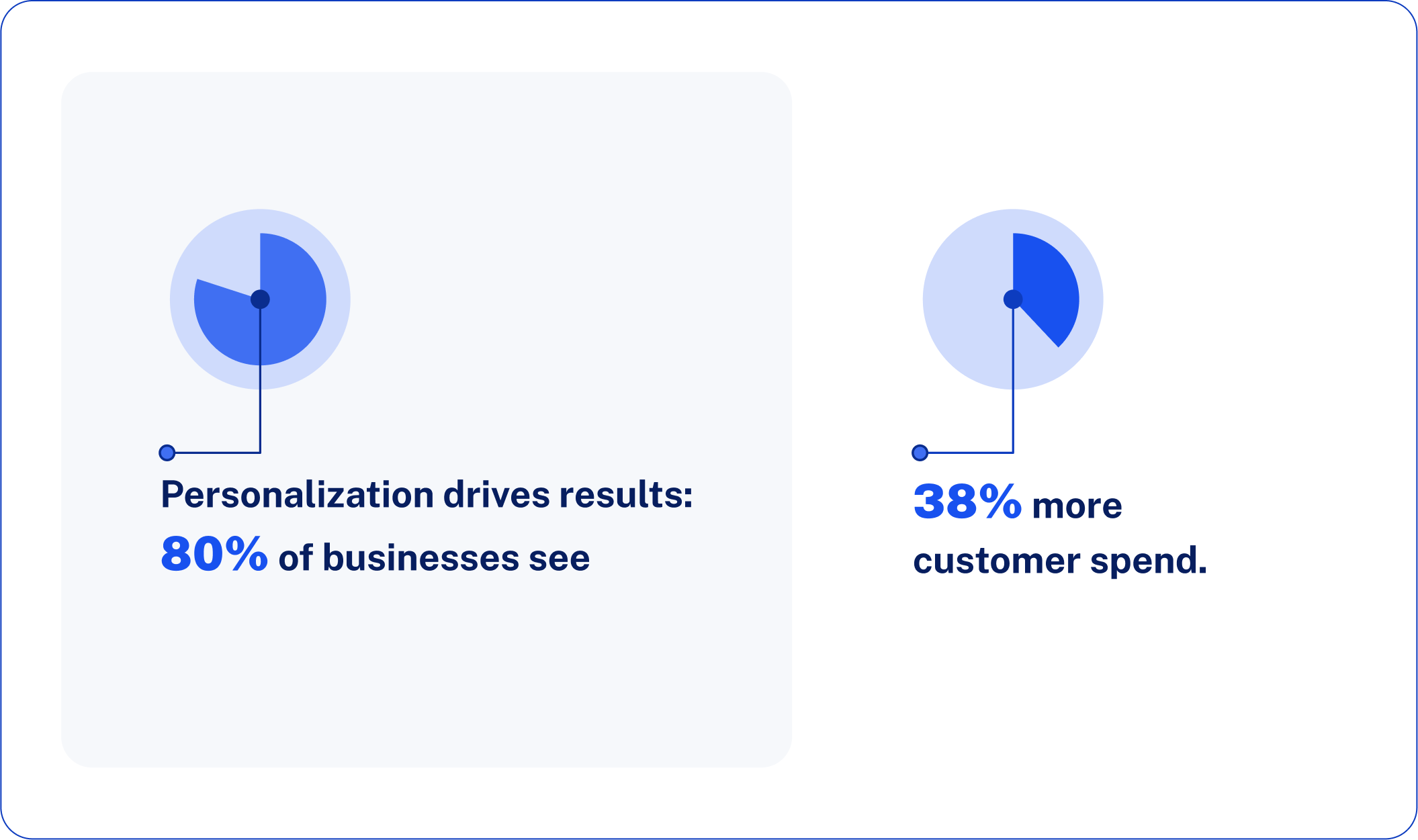
Here’s something you might already be aware of but maybe don’t quite appreciate: Your customers will expect personalized experiences. Indeed, 80 % of businesses claim they witness greater consumer expenditure, averaging 38 % more, when their experiences are personalized. But here’s something you might not realize: personalization without suitable data is like having a conversation in the dark.
Your information is what tells you that Seattle’s Sarah likes green products, buys online on her phone during lunch, and abandons her cart if shipping costs are too high. Without those bits of data, you’re basically firing marketing messaging at a wall and waiting for the best.
Your Quick Data Snapshot
Let’s analyze this in the most straightforward terms imaginable:
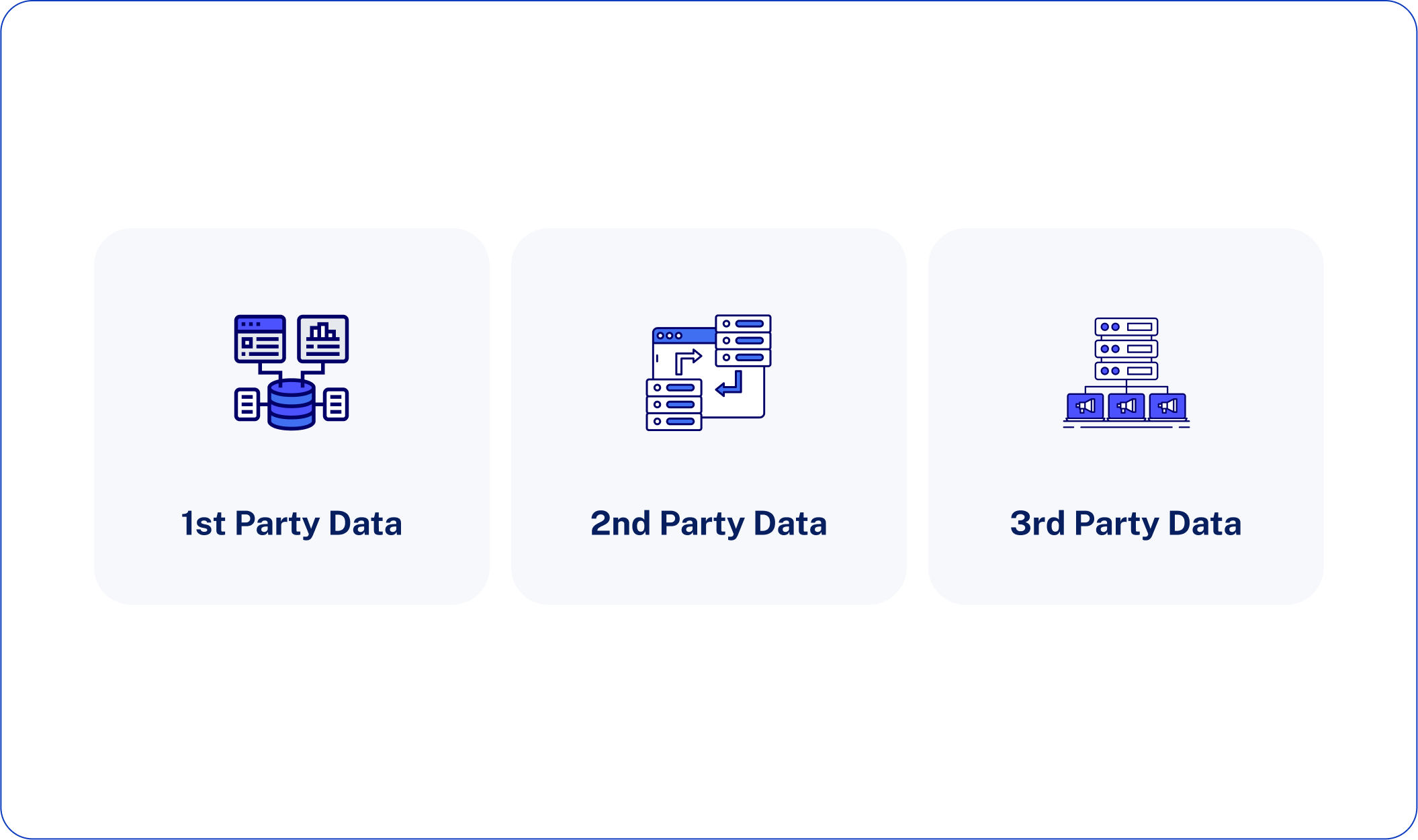
First-party data is information you collect directly from your customers. Think of it as data straight from the horse’s mouth: your website analytics, email subscribers, purchase history, and survey responses. It’s your data, you own it, and it’s the most accurate reflection of your actual customers.
Second-party data is another company’s first-party data that they’re willing to share with you. For example, if you’re a fitness app and partner with a healthy meal delivery company, you may exchange customer data to assist each other in developing superior experiences. It’s similar to taking your friend’s address book to invite people to a party.
Third-party data is information that’s collected by companies with no direct relationship to your customers, packaged, and then sold to you. These are the data brokers that take information from multiple sources and construct enormous databases of consumer behavior and demographics.
Now that you have the basics under your belt, let’s get more in-depth for each type so you can design a data strategy for your company.
What is First-Party Data?
First-party data is data you collect directly from your audience when they’re engaging with your company. It’s the data that’s directly from your customers, no go-between needed.
Examples
The following is what first-party data in your business will look like:
- Website Analytics: Page views, visitor traffic, time on site.
- CRM Data: Support requests, history of interaction, and contact with a customer.
- Email Subscribers: Click information, open information, opt-in information.
- Purchase History: It is the history of what has been purchased by the customer and when, and the frequency of purchase.
- Surveys and Feedback: First-hand customer opinion and feedback.
Benefits
Why your first-party data is your marketing goldmine:
- Accuracy: You precisely know where it came from and how new it is
- Ownership: All yours to own and run
- Compliance-Friendly: Much easier to be Privacy Regulation compliant since customers gave it voluntarily.
Limitations
The trade-off you need to understand:
Scale Can Be More Compact. You’re dealing with people who actually interact with your company, so your data set won’t be as large as third-party alternatives.
But keep in mind: a smaller cluster of customers you really know is better than a huge list of strangers you’re estimating about.
What is Second-Party Data?
Second-party data is another company’s first-party data that they’re sharing with you. It is borrowing excellent customer insight from a reputable business partner who has a first-party relationship with their customers.
Examples
- This is how second-party data operates in practice:
- Partnership Information: A fitness app sharing user exercise preferences with a sports apparel company
- Retail + Brand Partnerships: Share purchase data with CPG brands for enhanced targeting
- Loyalty Program Transfers: Traveling behavior of the members transferred between airlines and hotels
- B2B Partnerships: A CRM company providing usage statistics to marketing automation platforms
Benefits
Why second-party data is worth the chase: indeed
- Quality & Relevance: It remains first-party data quality, merely from the audience of a trusted partner
- Trusted Source: You know where it’s coming from and can verify for yourself
- Greater Exposure: Exposure to people you could not otherwise reach on your own
Limitations
The challenges you’ll face:
Dependence on Partnership: Your access solely relies on the good business relationship
Limited Scope: You only have a limited scope to what your partner is willing to disclose
Integration Difficulty: It is difficult to integrate multiple formats and systems
The secret is identifying partners whose users naturally complement your own, where cross-sharing data helps both companies.
What is Third-Party Data?
Third-party data is information that’s collected by different outside sources through businesses not directly connected to your customers. These data brokers collect, aggregate, and sell shopper data swept up from numerous points, applications, and websites.
Examples
It is here that third-party data typically begins:
- Data Brokers: Acxiom, Experian, Epsilon, and others that collect enormous databases of consumers
- Ad Networks: Websites that track activity on multiple websites in an attempt to target
- Cookie-Based Audiences: Tracking pixels that follow people around the web to build interest profiles
- Social Networking Websites: Facebook, LinkedIn, and Google are selling information on their users
Benefits
Why business and organizations have relied on third-party information:
- Broad Reach: Reaching millions of consumer profiles beyond your existing audience
- Scale: Instant access to enormous sets of data without decades of aggregation
- Audience Expansion: Bring on new customers similar to your best existing ones
Limitations
The growing problems with third-party data:
Accuracy Issues: Data quality deteriorates as it goes through multiple hands
Privacy Laws: GDPR and CCPA make it expensive and risky to use
Cookie phase-out: Chrome and other browsers have phased out third-party cookies in 2024
It’s on the wall: third-party data worsens by being less precise, more expensive, and harder to use legally. Savvy businesses are already turning towards first and second-party alternatives.
First, Second, Third-Party Data: Key Differences
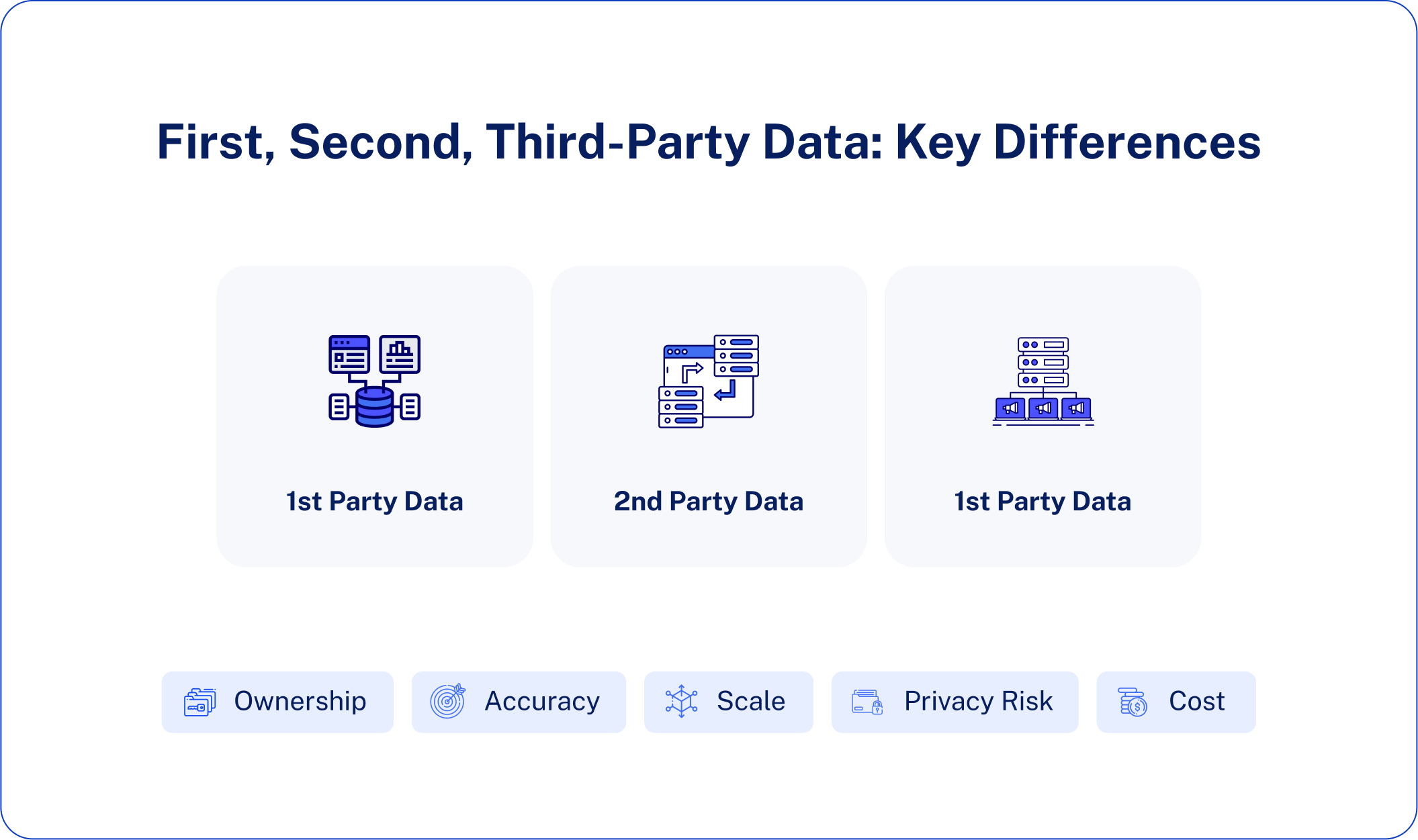
This is how the three types of data compare to each other on the metrics most critical to your company’s needs. Understanding these differences will help you make better choices regarding where to invest your data, spend, and effort.
Ownership
First-Party: It’s all yours – yours to control and use as you wish. No vendor can magically change terms, pull the plug on access, or bump up the price. You determine how it is kept, who gets access, and how long it remains. This complete ownership affords you the freedom to tinker and innovate without outside impediments.
Second-Party: Shared ownership through partnership; your access is purely tied to being on good terms with them. As long as the data quality is excellent, you’re totally in their hands regarding what they want to do with their business. When they choose to end the partnership or change their data sharing policies, your access disappears overnight.
Third-Party: You’re just renting it; everything belongs to and is controlled by the data broker. You pay to utilize it, but have no input on price changes, data quality standards, or access. Too many firms learned this the hard way when their third-party data provider suddenly altered terms or disappeared.
Accuracy
First-Party: Most reliable since you collected it directly from your customers, with no go-between twisting the information. You know pretty well when you collected it, under what circumstances, and how fresh it is. There is no telephone game warping the info in different hands.
Second-Party: Extremely high accuracy since it’s somebody’s first-party data, but there can be some loss during the sharing. Differences in data formats, data collection processes, or timing may create minute gaps. But it’s still much better than third-party.
Third-Party: Less precise due to declining data quality with each hand it goes through. By the time the information lands in your hands, it has perhaps been aggregated, standardized, and processed numerous times. Data brokers tend to compile data from numerous sources, leading to contradictory or outdated information regarding the same individual.
Scale
First-Party: Limited to the size of your audience – you only see data from the people who actually interact with your business. For smaller or younger organizations, this might mean starting with hundreds or thousands of data points at most. But this limitation tends to make you invest in quality relationships more than chasing vanity metrics.
Second-Party: Medium-sized, which is based entirely on the size of your partner’s audience and how much they can give. Being with a large company might give you access to millions of customers’ insights, while a smaller one will give you only thousands to add to your database. The key is to find partners whose audiences naturally complement each other.
Third-Party: Massive scale with visibility into millions of consumer profiles instantly. Data brokers have spent years gathering data from half a million sources, giving you instant visibility into demographic, behavioral, and psychographic information for entire markets. The scale is massive, but at the expense of tremendous trade-offs somewhere else.
Privacy Risk
First-Party: Very little risk because the customers permitted you themselves, so compliance with privacy law is much easier. You have clear records of consent, you know exactly what data you collected, and you can just fulfill customer requests to delete or modify data. Having this visibility makes legal compliance much less painful.
Second-Party: Medium risk that requires absolutely clear partnership agreements and reasonable consent management by both parties. You need to ensure your partner legally sourced their data and that customers consented to it being shared. Any compliance gaps by your partner become your problem too.
Third-Party: High risk with burdensome compliance requirements for GDPR, CCPA, and emerging privacy regulations. You often don’t even know how the data was collected, what consent was obtained, or if customers even realized their data would be sold. This ignorance creates significant legal and reputational risk to your business.
Cost
First-Party: The least recurring cost since you spend mostly on infrastructure, collection equipment, and the time of employees. While you make a one-time investment in systems and processes, the long-term cost per data point is minimal. Plus, you’re building an asset that appreciates over time compared to recurring fees.
Second-Party: Medium cost with partnership management, legal agreements, technical integration, and often revenue-sharing arrangements. You might pay your partner directly, trade your own data for theirs, or split the cost of joint marketing programs. These take ongoing investment but can provide outstanding ROI.
Third-Party: Most costly with high integration cost, compliance fees, and licensing fees. Quality third-party data doesn’t come cheap, and the prices keep on rising as privacy laws make it increasingly difficult to gather data. You’re also paying for data that can become obsolete or be blocked at a whim.
First-party data is the accuracy and privacy winner, third-party wins on scale, and second-party offers the most compromise. Your ideal solution? Start with first-party as your foundation, and then opportunistically layer in the others based on your specific needs.
Which Type of Data Should You Use?
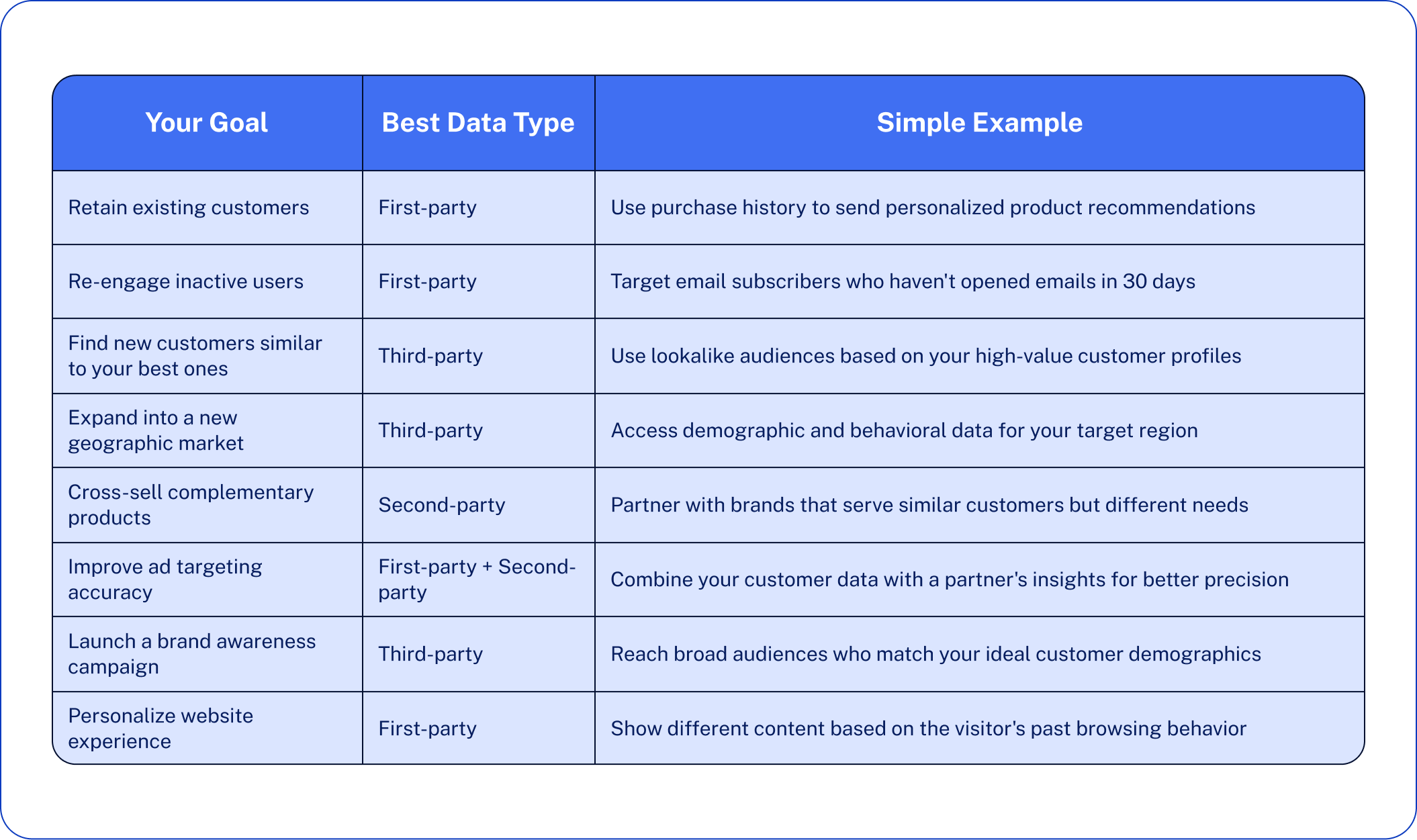
The answer isn’t choosing one, it’s choosing the right data type for your specific goals and then using them correctly in conjunction with one another.
Aligning Data with Your Goals
For Personalization
- Opt for first-party data for those “how did they know I needed this?” moments.
- Make use of purchase history, browsing behaviors, and overt customer taste
- No better than the precision of data captured directly from your own customers
For Scale and Reach
- Third-party data gives you the scale to cast a broader net
- Best for going to market in new areas or finding lookalike customers
- Opens up access to millions of consumer profiles that are not in your current user base
For Compliance and Safety
- First-party data is your best option, with privacy laws getting more and more restrictive.
- You know precisely what permission you have and can deal with it accordingly.
- Customers volunteered this data to you willingly
The Power of Combination
That’s where clever marketers get ahead; they intentionally stack various kinds of data. Start with your first-party data as your dependable cornerstone, supplement it with second-party partnerships to propel reach with high-quality audiences, and finally utilize third-party data to plug targeted holes and blind spots.
Think of it like building a house: your first-party is your foundation, your second-party builds your walls, and your third-party puts in the finishes.
Why First-Party is the New Gold Standard
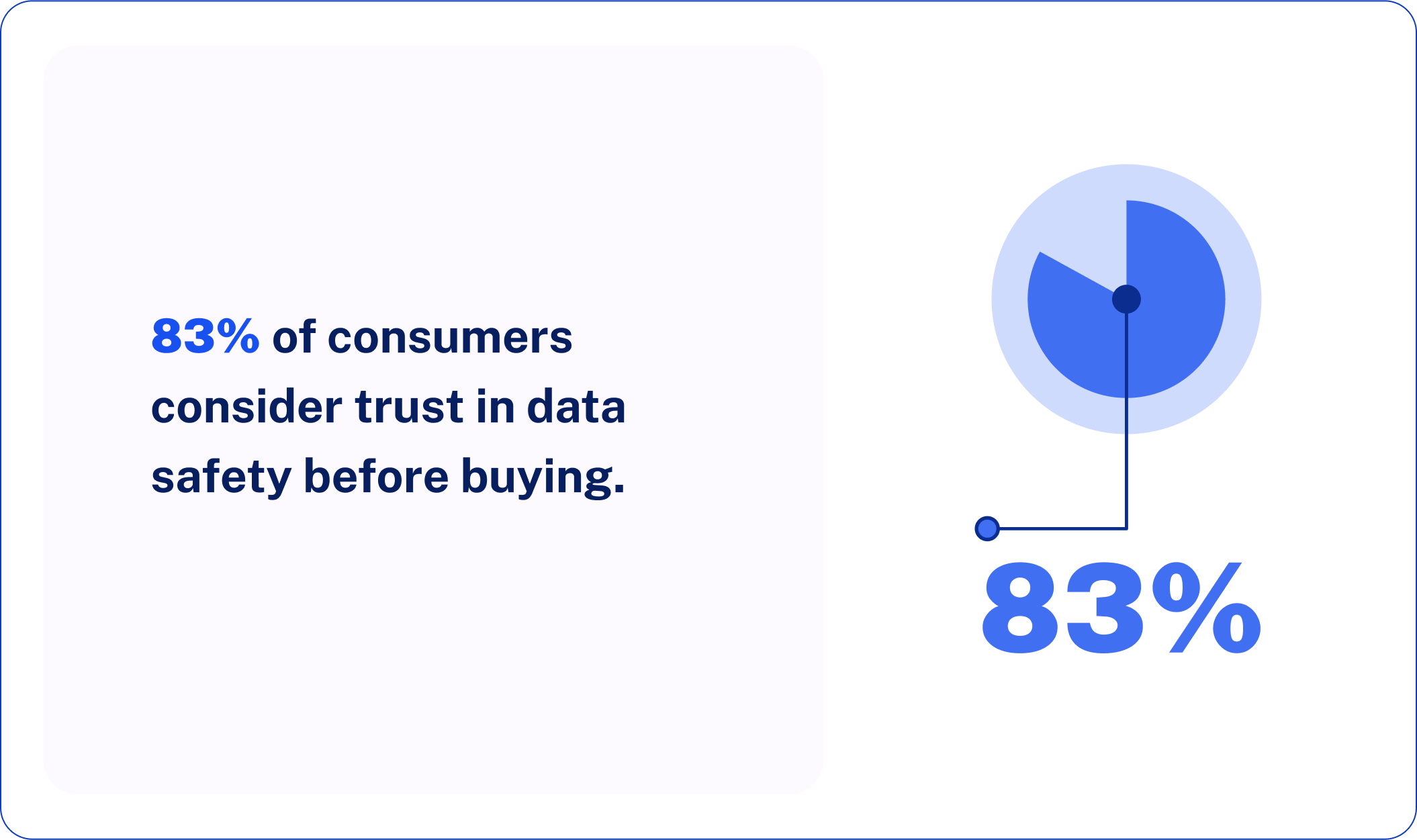
As the cookieless world looms, first-party data isn’t just worth its weight in gold; it’s essential. 83% of consumers say they weigh whether they are okay with a company keeping their information before making a purchase, and privacy legislation is tightening everywhere on the planet. Companies with direct consumer connections will thrive while those that subsist on third-party data will be playing catch-up.
Your first-party data strategy isn’t just about better marketing tomorrow, it’s about future-proofing your business for the day after tomorrow.
Use Case Optimization Guide
Real-World Examples of 1st, 2nd and 3rd party data
It is one thing to understand the theory behind first-, second-, and third-party data, but seeing how organisations apply them in practice is where their value becomes evident. Some real-world examples of where each type of data has its role in marketing today are as follows:.
E-commerce brand using first-party data for upselling
Leading DTC brands send restock reminders or upsell packages based on first-party purchase history and browsing behavior. Say, for instance, that a consumer buys a 30-day supply of something; on day 25, they get an email with a bundle offer or a complementary accessory.
What Data Type + How It’s used:
First-party data, which is collected directly from the customers via purchases, site behavior, email/SMS interaction, etc.
Travel/transport company using second-party data
Eurostar partnered with a premium publisher in order to use second-party data (publisher audience segments) in their sales activation campaigns. By doing this, Eurostar was able to use authenticated, quality data from the partner rather than relying on off-the-shelf third-party segments.
What Data Type + How It’s used:
Second-party data, data a partner or the publisher initially collected, then licensed under an agreement, enabling more precise targeting.
Ad network/platforms using third-party behavioral segments
An ad platform or DSP building campaigns from third-party audience segments: these are pooled behavioral or interest-based audiences not yet in the advertiser’s own customer database. These segments enable advertisers to reach prospects beyond their direct contacts, on the basis of inferred interest from browsing across a multitude of sites.
What Data Type + How It’s used:
Third-party data, beyond aggregated data used to target customers other than your direct ones.
The Future of Data-Driven Marketing with AI Ark
The cookie-less marketing world is transforming at a pace. With cookies disappearing and privacy calls mounting, businesses can no longer afford to engage in old habits. Success will instead be a matter of how well you leverage several sources of data in more intelligent and responsible ways.
And here’s the concise summary:
- First-party = owned: your most valuable, accurate, and compliant asset.
- Second-party = shared: partnerships that expand your audience with groups you trust.
- Third-party = bought: scalable, but with growing problems of accuracy and consent.
You now understand the three types of data and when to use each one. But knowledge is not application. The cookieless future is already here. Those organizations that wait will be left behind, and those who act today will own their markets.
Don’t let your competition get ahead of you while you’re still figuring out your data strategy.
Ready to leverage your customer data as your most important competitive advantage? We help businesses design future-proof data strategies that yield measurable results at AI Ark.
Your customers are already giving you the information that will allow you to make it; the question is:
Are you using it effectively?
Book a demo with AI Ark and start building your data-driven future today.
FAQs on First Party, Second Party & Third Party Data
1. How is the initial difference among first-party, second-party, and third-party data characterized?
The difference is in who collects the data and how near they are to your customers.
First-party data is collected directly from your customers by your own channels.
Second-party data is another company’s first-party data that is made available to you through partnerships.
Third-party data is collected by external aggregators or brokers who sell on access to large audience datasets.
2. Why is first-party data more highly valued in 2025?
With third-party cookies eliminated and laws like GDPR and CCPA limiting the utilization of bought data, businesses cannot rely on bought data any longer. First-party data offers precision, permission, and long-term value and therefore is the most compliant and sustainable way to understand your audience.
3. How can small businesses start collecting first-party data effectively?
Start with the tools you already have:
- Leverage website analytics to track visitor behavior.
- Create an email list with clear opt-ins.
- Use surveys and feedback forms to understand customer interests.
- Encourage account creation or loyalty programs to collect purchase history and engagement metrics.
- Even small datasets can provide powerful insights when analyzed strategically.
4. Is third-party data still worth using?
Yes, but with caution. Third-party data can still help with reaching new audiences or expanding reach, especially when entering new markets. However, with data privacy concerns and accuracy issues, it’s safest to use it as a supplement to first- and second-party data, not your go-to source.
5. How do I combine first-, second-, and third-party data for maximum effect?
Conceptualize them as layers of intelligence:
- Start with first-party data as your foundation for accuracy and personalization.
- Layer on second-party data from carefully chosen partners to extend reach with proven audiences.
- Employ third-party data judiciously to uncover optimized opportunities and confirm market segments.
- Together, they create a solid, balanced strategy that yields personalization, compliance, and growth.